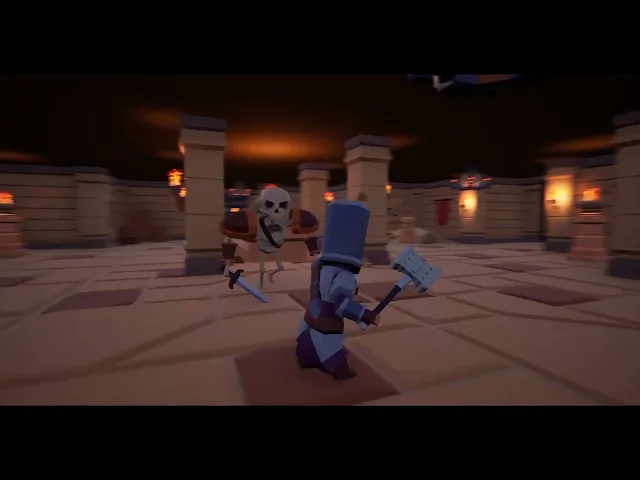

PLUNDERING KNIGHTS
Project Type
Personal Project
Duration
Ongoing
Team Size
Solo
Engine
Unreal Engine 5
Genre
Action Arcade
Project Focus
Game Design • 3D Art • Level Design • Environment Art • Gameplay Programming • UI/UX
OVERVIEW
Plundering Knights is a solo-developed third-person action arcade game inspired by the design principles of NES and SNES-era games. Players enter a dungeon with a limited amount of time to explore, fight skeletons, and collect as much treasure as possible.
Defeating enemies adds time to the clock, encouraging players to engage in combat rather than simply rushing between treasures.
The game is built around a simple
Explore → Combat → Rewards loop, with score-driven gameplay and replayability at its core.
The game takes inspiration from the design principles of older NES and SNES games. As a solo developer, I use similar limitations as a framework for deciding what the game needs and, just as importantly, what it doesn't.
Small levels, a controlled number of enemy types, and simple mechanics keep the game focused on its core loop while maintaining a manageable development scope. New features are considered based on how well they support the existing gameplay rather than simply adding more complexity.
As a solo developer, defining strict boundaries early on was essential to this project in order for me to get it off the ground. By committing to small levels, simple mechanics and interactions, the project keeps its direction and momentum.
This structured limitation and approach ensures that design decisions I make never creates any feature creep, and it helps me have a good production discipline.
Design Philosophy
& Constraints
The project follows three main constraints, inspired by older game design:
Small, contained levels instead of open-world environments
Limited enemy types and behaviors
Simple mechanics
These constraints made sure that every mechanic serves the core loop and that development remains manageable as a solo project.
Core Gameplay Loop
Select a Knight
Select a level
Enter a time-limited location
Collect as many treasures as possible
Survive against enemies
Finish with a score based on performance
Core Player Tension
The central tension of the game is
risk versus reward.
Players must constantly decide:
Do I push deeper into dangerous areas for more treasure?
Do I engage enemies to clear a path or avoid them to preserve health?
Do I prioritize survival or maximize score?
Time pressure forces commitment to decisions. Greed increases risk, and hesitation reduces scoring potential. The player’s success depends on balancing aggression and caution.
Development began by establishing the core movement and combat systems. Melee attacks, shield blocking, the basic skeleton enemy, and treasure collection formed the foundation of the game.
The visual direction was established early, allowing later development to focus primarily on expanding the gameplay and adding more player choice.


Early development builds: Testing combat, UI, and the initial dungeon environments.
BUILDING ON THE CORE
Once the core gameplay was in place, I focused on expanding the existing systems rather than changing the game's foundation. New mechanics were introduced to add more variety to combat, exploration, and treasure collection.
EXPANDING PLAYER CHOICE
One Knight → Three Playable Knights
The game originally featured a single playable knight. I later expanded the roster to three characters with different weapons and attributes, giving players a choice between balanced, stronger, and faster playstyles.

MAKING TREASURE MORE ACTIVE
Treasure → Carryable Chests
Carryable chests were added to make treasure collection more active. Players must bring them to a drop-off point before their value is added to the score, tying treasure collection more closely to movement and exploration.

ADDING COMBAT OPTIONS
Melee → Throwable Axes
Throwable axes introduced a ranged option without replacing the game's melee combat. Instead of dealing damage, axes stun enemies and create an opening for the player to attack.

DESIGNING RISK VS REWARD
Every mechanic in Plundering Knights was designed to support a single goal:
Encouraging players to continuously balance risk against potential reward.
Rather than following a fixed path, players are constantly presented with choices that affect both their score and their chances of survival.
Time vs. Treasure

Treasure increases the player's score, but collecting it often requires exploring deeper into the dungeon or carrying valuable chests back to safety. The further players push, the greater the potential reward, but also the greater the danger.
Combat vs. Survival

Enemies consume valuable time and health, but defeating them extends the timer. Players must decide whether engaging in combat is worth the extra time it provides or whether avoiding encounters is the safer option.
Exploration vs. Progress

Keys, treasure, and optional rewards encourage exploration, while the timer constantly pressures players to keep moving. Choosing when to search for more loot and when to progress towards the boss becomes part of every run.
Preparation vs. Commitment

Player choices begin before entering the dungeon. Different knights and equipment influence how each run unfolds, encouraging experimentation without changing the core gameplay loop.
DESIGN SUMMARY
Rather than relying on complex systems, Plundering Knights builds depth by combining simple mechanics that influence one another. Combat, exploration, treasure collection, and time management all contribute to a gameplay loop that rewards both planning and quick decision-making.


